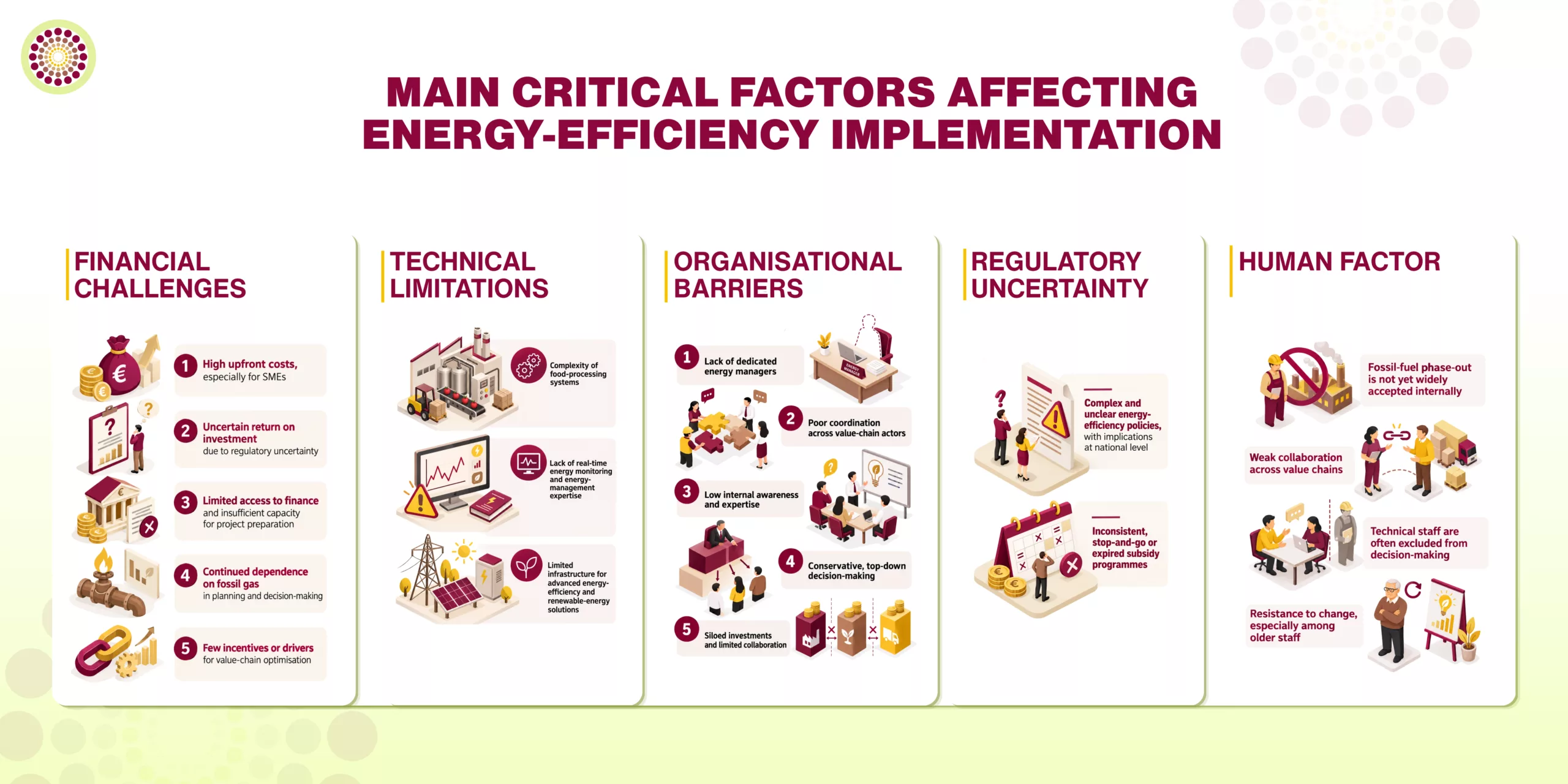

Local cooperation between companies can be a powerful driver of innovation, sustainability, and competitiveness. A strong example of this can be found in Bulgaria’s wine sector, where several companies have joined forces to address shared challenges related to energy use, resource efficiency, and environmental impact. Their collaboration demonstrates how working together locally can create practical solutions that benefit individual businesses while strengthening the entire value chain. Black Sea Gold, BATA 2002, and POPKOMERS have partnered to tackle common challenges, focusing on energy management, resource optimisation, and environmental stewardship. Within EENOVA, this type of regional cooperation is seen as a key enabler for effective energy efficiency improvements. The project works directly with food processing value chains to help companies identify shared priorities and translate them into coordinated actions rather than isolated efforts.
The cooperation leverages complementary roles: BATA 2002 manages vineyards and irrigation, Black Sea Gold oversees wine production, and POPKOMERS handles logistics. Together, they have developed strategies around efficiency upgrades, renewable energy adoption, and phased investment planning. A standout initiative is the circular use of by-products: Black Sea Gold’s grape pomace is repurposed by BATA 2002 as natural fertiliser, reducing waste, chemical use, and costs. Energy efficiency improvements – including automation, digital monitoring, and photovoltaic systems – further benefit all partners. Shared expertise in irrigation and logistics helps minimise investment risks and accelerates learning across the network. This combination of technical measures, operational coordination, and realistic investment planning mirrors the methodology applied in EENOVA, where energy audits and implementation pathways are designed with both individual company needs and value chain dynamics in mind.
By aligning operational goals, pooling resources, and building circular practices, these companies are not only enhancing their own performance but also contributing to the resilience and modernisation of Bulgaria’s wine sector. This example illustrates that local cooperation is more than coordination – it is about creating shared value, fostering trust, and developing solutions rooted in real operational needs. In the EENOVA framework, these collaborative dynamics are further strengthened through facilitated exchanges and regional roundtables, enabling companies to move from discussion to concrete joint actions on energy efficiency and resource use.
Beyond these immediate benefits, such collaborative models also strengthen the sector’s global competitiveness. By demonstrating that sustainability and efficiency can be achieved through local partnerships, Bulgaria’s wine producers position themselves as innovators in environmentally conscious production. This approach encourages other regions and industries to explore similar synergies, showing that local collaboration can be a catalyst for broader economic and ecological impact.
At project level, EENOVA focuses on capturing and transferring these experiences so they can inform similar initiatives across other food processing sectors and regions, supporting wider uptake of proven, value chain-based energy efficiency solutions.