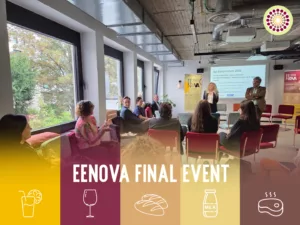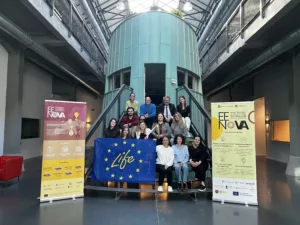
Through the EENOVA project, food processing companies in five European regions are carrying out energy audits to better understand their consumption and identify realistic efficiency improvements. In Upper Austria, this work includes the bakery and milling value chain, where companies like Knollmühle are using the audit results to make informed decisions on energy use and investments.
Knollmühle in St. Georgen an der Gusen manufactures more than 80 products for commercial bakers, processors, and retailers. The grain comes from various Austrian growing regions. Before being ground, the grain is specially prepared and cleaned. Knollmühle needs a large warehouse to store the wide variety of valuable raw materials for its diverse range of milled products and baking mixes. Sufficient storage capacity is also required to ensure that the flour matures optimally. “We need a lot of energy, especially for grinding and conveyor technology,” reports Lukas Josef Knoll, managing director of Knollmühle. The SME therefore carried out an energy audit for the first time as part of the EU project EENOVA. In this interview, Knoll talks about his experiences.

What was your main motivation for conducting the energy audit?
First and foremost, self-interest: we wanted to gain a better understanding of our actual consumption and identify potential for improvement. Another motivation was to take the lead for our forward-looking customers. And we wanted to identify and leverage synergy effects along the value chain.
How complex was the audit, and what was the most complex part?
Thanks to good preparation and a practical, competent auditor, the audit itself was manageable in terms of effort and more instructive than many other audits. The most time-consuming part was the data collection in advance.
What were the biggest eye-opening moments for you?
The biggest eye-opener was that relatively easy-to-collect data can be used to feed meaningful calculation models that generate concrete recommendations for action, including economic analyses. We were most surprised by the auditor’s cross-industry experience and his very practical approach.
Where did you discover the greatest potential for optimization? And what will you implement most quickly now?
I see the greatest potential in our conveyor technology. As a first step, we will implement optimizations in plant control and automation. We have identified several scenarios that will make our pneumatic transport systems more efficient by fine-tuning the underpressure and overpressure. We would like to implement this in the near future.
We will also take a closer look at the potential for road transport: our car fleet already includes four electric vehicles. A prerequisite for electrifying our current fleet of diesel trucks is charging stations and a blower for unloading at our customers’ sites. In the near future, such a solution is most likely to be implemented with selected major customers who are visited several times a week and who have the necessary infrastructure or are willing to invest in it.
What do you think of the Energy Efficiency Act, which since the beginning of the year has required certain companies (more than 249 employees, exceeding certain economic indicators) to conduct an energy audit every four years?
I think energy audits like this make sense. However, I don’t believe in coercion. The market will increasingly demand such audits—alongside other ongoing improvements in the environmental sector—regardless of legislation. The law could accelerate this process.
What tips do you have for companies conducting an audit for the first time?
Don’t be afraid of excessive administrative and bureaucratic effort. It is more practical than you might think and can quickly provide valuable optimisation tips that also have a monetary impact.
Knollmühle’s experience illustrates how EENOVA translates energy audits into concrete, company-level action while keeping a clear value chain and regional perspective. This interview was carried out by Business Upper Austria, a project partner of EENOVA. Over the coming months, we will share stories from all five regions where EENOVA is active, highlighting practical examples of how food processors across Europe are improving energy efficiency in their daily operations.
Don’t miss out on anything, follow us on LinkedIn and BlueSky.