Energy audits enable companies to identify opportunities to reduce energy use, costs and emissions while improving productivity. However, identifying a measure in an energy audit does not necessarily mean that it will be implemented.
The EENOVA analysis examines opportunities to improve energy efficiency and increase the use of renewable energy sources in food-processing value chains. IRI UL led the analysis of critical factors and opportunities for improving energy efficiency. These go beyond simple lack-of-money issues, which are sometimes an excuse for other issues hindering EE implementation.
Energy efficiency is not only a matter of technology
The analysis examined what happens after an energy audit or after energy-saving measures are identified: which proposals companies find attractive, which reach the implementation stage, and why some remain unrealised despite identified energy and economic benefits.
Common measures analysed in companies from five countries include photovoltaic systems and energy storage, energy management and energy monitoring systems, heating and cooling optimisation, waste heat recovery, efficient lighting, compressed-air optimisation, and the electrification of processes and logistics. Technical feasibility, however, is only one of the conditions for successful implementation.
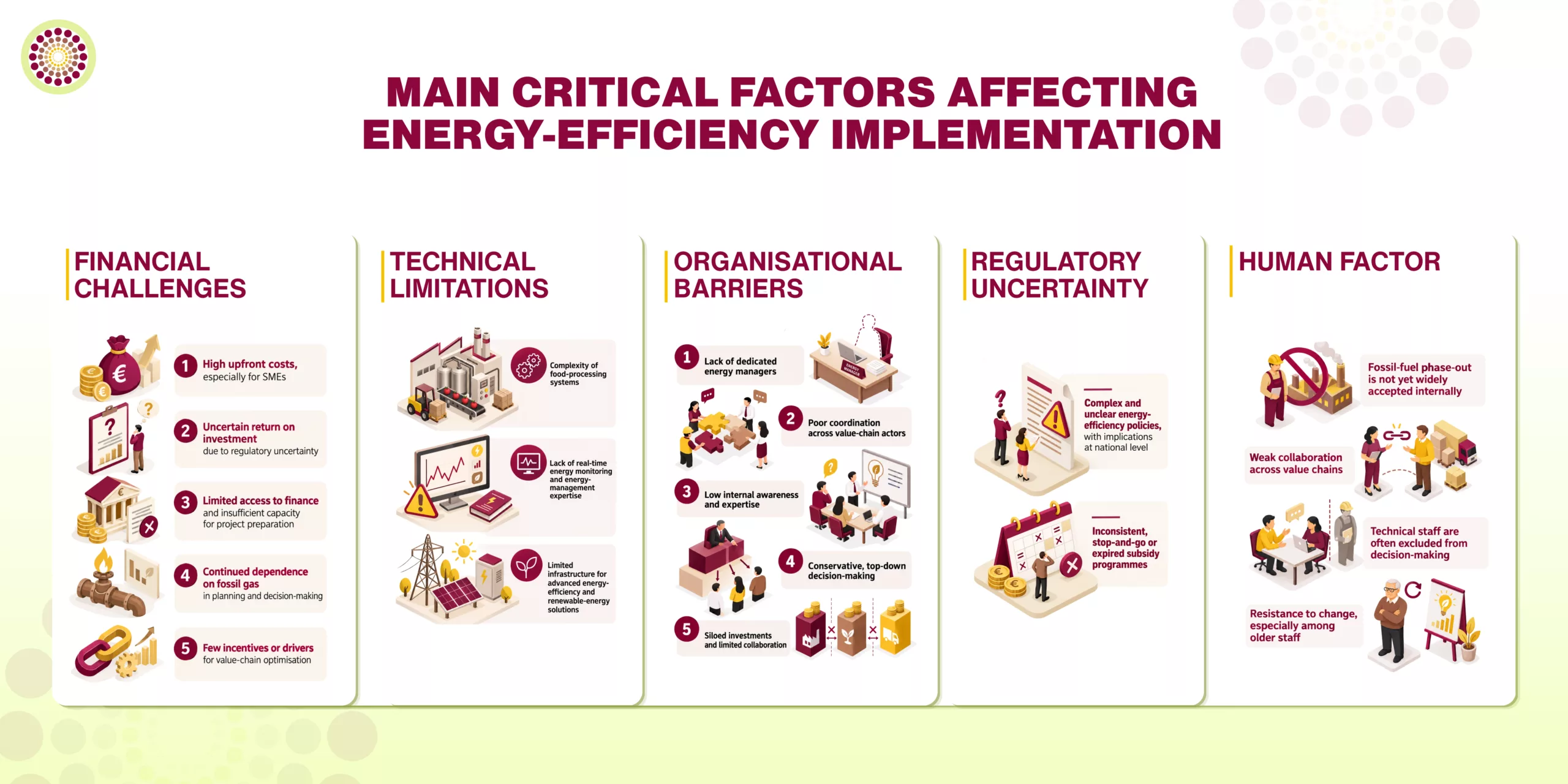
Five groups of barriers to implementation
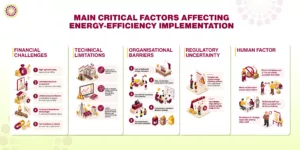
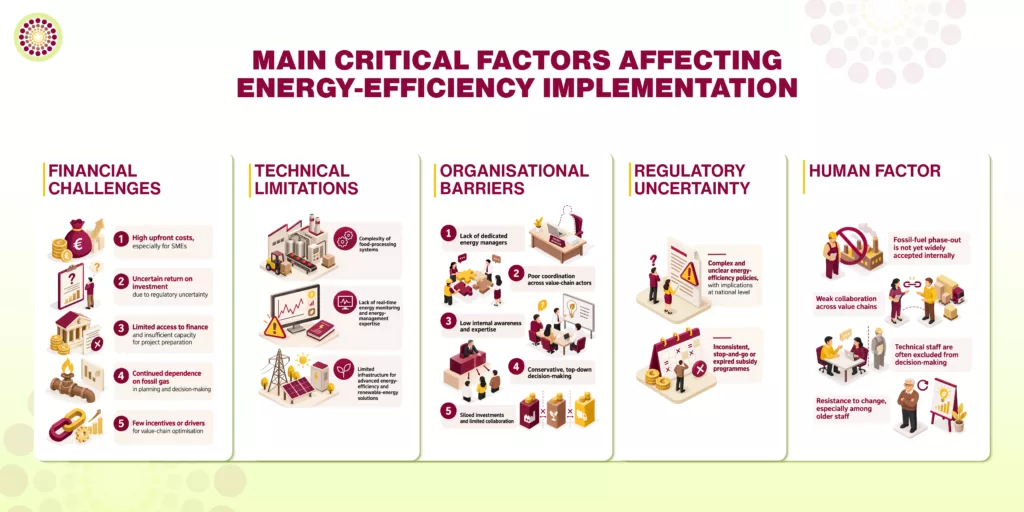
A comparison of companies in the countries included in the analysis revealed five groups of factors: financial, organisational, technical, regulatory and human. Financial barriers include high upfront costs, uncertainty regarding return on investment and limited access to financing. Organisational challenges include a lack of specialised energy-management staff, weak cooperation between departments and conservative decision-making. Technical barriers include process complexity, a lack of data and real-time monitoring, while regulatory barriers include unclear procedures, delays and instability of support schemes in some countries.
Slovenian experience: measures are identified, but implementation is not automatic
The Slovenian analysis included two companies. First is improving energy efficiency through the integration of solar energy, condensate heat recovery and upgrades to energy systems, while second focuses on measures such as more energy-efficient machinery, improvements to the building envelope and use of recycled materials.
The discussions showed different levels of investment readiness. Some measures had already been implemented, while others are planned for near future.
The Slovenian case clearly demonstrates that a company’s readiness does not necessarily guarantee rapid implementation. Solar PV projects have faced administrative delays in obtaining the necessary approvals, while decision-making is also affected by changes in electricity prices and network charges. At the same time, production optimisation through more efficient machinery has shown that technological upgrades can directly reduce energy consumption.
From individual companies to the entire value chain
Companies already optimise many aspects of energy use, production, procurement and logistics within their own operations and established business relationships. The value-chain perspective complements these existing practices: by looking beyond the boundaries of a single company, it can reveal additional opportunities that may not be visible when investments and operational decisions are planned separately. The analysis identified possibilities such as joint procurement of photovoltaic systems and energy storage, shared infrastructure for e-mobility, logistics optimisation, coordination of production batches, exchange of energy data, and transfer of knowledge and good practices.
The Slovenian case shows that such cooperation can build on practices that companies already use. The long-term relationship between the companies has already resulted in process improvements, including bottle-weight optimisation. A broader value-chain view identified further possibilities, such as better coordination of production batch sizes and storage, improved pallet loading, and more efficient transport planning. These measures can reduce energy use and costs while also lowering emissions across the supply chain.
More formal energy-focused cooperation, joint investments and shared infrastructure are still at an early stage. Nevertheless, the results indicate that coordinated planning can reduce costs and risks and can reveal projects or synergies that would be less attractive, or even overlooked, when assessed by an individual company alone. This is particularly relevant for small and medium-sized enterprises with limited financial and human resources.
An energy audit should be the beginning of the process, not the end
The results convey a clear message: an energy audit achieves its true purpose only when its findings lead to concrete measures. It should therefore not be merely a snapshot of the current situation and a list of potential savings, but a basis for investment planning and long-term energy management within the company.
This requires high-quality energy data, clearly defined responsibilities, the involvement of technical staff and management, and realistic financial assessment of measures. For more demanding investments, a phased approach is advisable: from less complex measures and pilots to larger systems and, ultimately, the entire value chain.
Energy monitoring and management systems such as BMS, SCADA and energy monitoring platforms, as well as approaches based on EN 50001 principles, play an important role. Without high-quality data, it is difficult to assess the effects of measures and verify the savings achieved.
What do findings recommend?
Key directions include phased implementation of measures, tipization of energy data and monitoring, involvement of energy managers and cross-functional teams, and improved access to financial incentives. For larger investments, a stable regulatory and support environment is particularly important.
Critical factors also in focus at the Energy Audits 2026 expert event
The question of how to translate the results of energy analyses into actual savings will also be in focus at the expert event “From Energy Analyses to Savings: Energy Efficiency and Integration of Renewable Energy Sources in Industry”, organised by Borzen on 7th October 2026 at the Crystal Palace in Ljubljana.
In the presentation “Critical factors affecting the implementation of energy efficiency and the use of renewable energy sources”, Jure Vetršek from the Institute for Innovation and Development of the University of Ljubljana (IRI UL) will present experiences and findings related to the factors that influence the actual implementation of energy-efficiency and renewable-energy measures.
The findings from the EENOVA analysis provide an important basis for discussion: in many cases, the technologies and potential savings are already known. The next challenge is to create financial, organisational, technical and regulatory conditions that will enable companies to make effective use of these opportunities.
More information and event programme: Borzen – Energy Audits 2026 Expert Event