On 17 July 2026, the European Commission published its new Electrification Action Plan, COM(2026) 595, setting out measures to accelerate electrification across the European economy. Europe’s transition to decarbonised electricity offers food and drink manufacturers, particularly SMEs, a practical route to cut emissions, strengthen energy security and remain competitive.
Read the European Commission’s Electrification Action Plan (COM/2026/595)
For food manufacturers, however, effective electrification means more than replacing fossil-fuelled equipment with electrical alternatives. It requires efficient production processes, access to renewable electricity and greater flexibility in when and how energy is consumed.
For food manufacturers, this transition raises some very practical questions. And for EENOVA, the EU-funded project working with regional food-processing value chains, many of them are already familiar. Some of EENOVA companies already generate renewable electricity providing a best practice on how replacing fossil fuels in processes such as heating, cooling, cleaning, pasteurisation and steam production.
Technologies such as heat pumps and electric boilers can support this transition, but they must be appropriately sized and integrated. Before electrifying a process, manufacturers should identify avoidable losses, recover waste heat and optimise production. This is why energy audits and energy management systems are essential. Audits establish where, when and why energy is consumed, while energy management systems enable companies to monitor performance and improve it continuously. Together, they help SMEs prioritise investments, reduce electricity demand and ensure that renewable electricity is used effectively throughout production.
Flexibility is equally important. Some energy-consuming activities can be shifted to periods when renewable electricity is abundant, grid demand is lower or prices are more favourable, without compromising food safety, product quality or output. Storage, smart controls and adaptable production schedules can help businesses manage demand, reduce costs and support a power system increasingly supplied by wind, solar and water.
Electrification opportunities also extend beyond factory processes. Electric tractors and other agricultural machinery can reduce fossil-fuel use in primary production, while electric forklifts, service vehicles and on-site transport can lower emissions within food-processing facilities. Across the wider value chain, electrifying freight, distribution fleets and last-mile delivery can further reduce the carbon footprint of food and drink products.
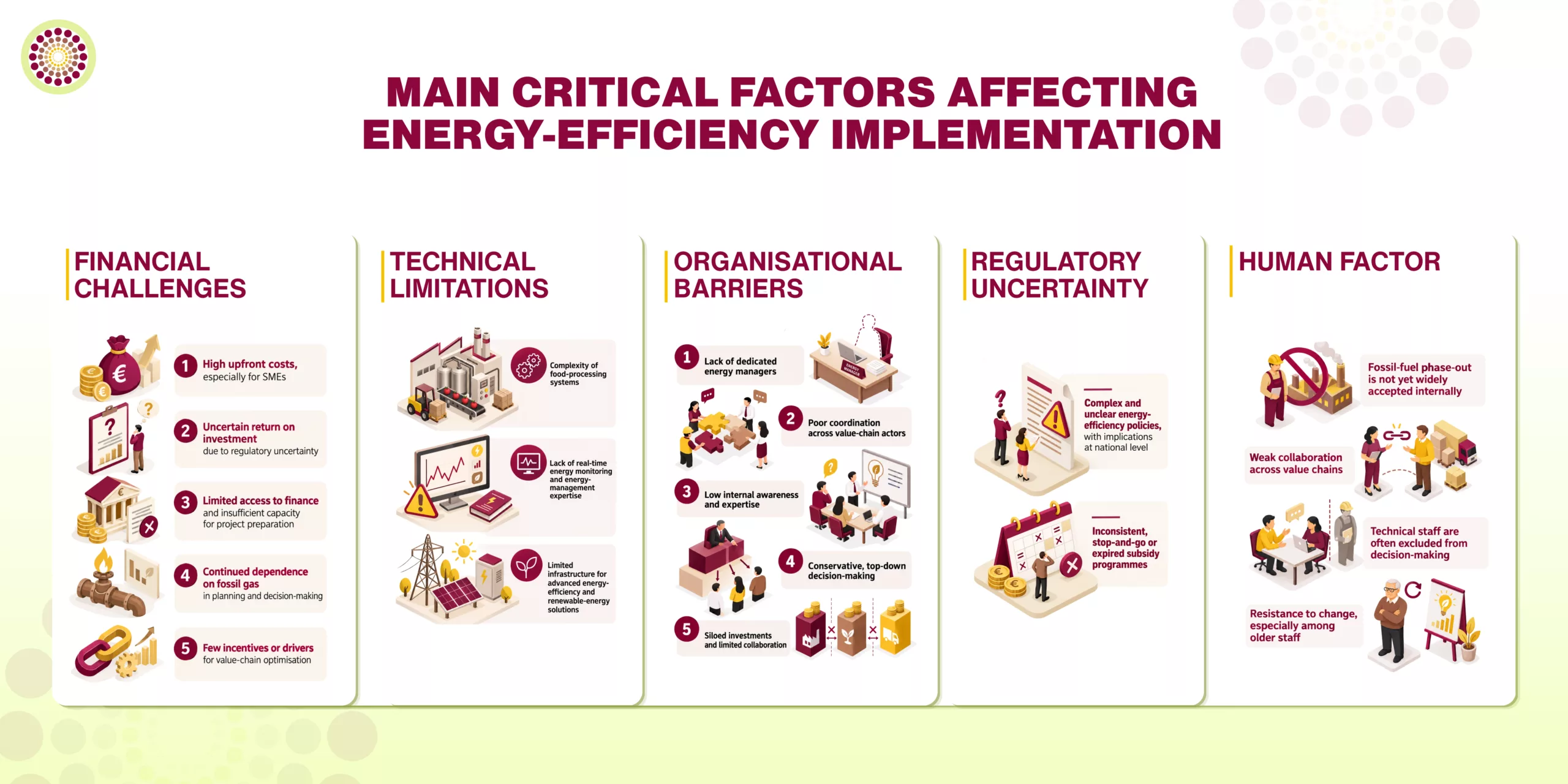
EENOVA’s value-chain approach shows that these changes cannot always be delivered by individual SMEs acting alone. Manufacturers, farmers, logistics providers, technology suppliers, energy agencies and grid operators must coordinate investments and address shared barriers.
Effective decarbonisation will therefore depend on a clear sequence: reduce unnecessary demand, manage energy efficiently, electrify suitable processes and transport, use decarbonised electricity, and introduce flexibility wherever operations allow. For food and drink SMEs, this approach can turn electrification from a policy ambition into practical, investable action.