What does it take for Europe’s food industry to move from identifying energy inefficiencies to shaping credible transition pathways? EENOVA’s third roundtable series answers this question by converting technical findings into structured scenarios that companies and policymakers can actually work with. Roundtable 3 represents the moment when regions stop simply diagnosing energy problems and begin debating realistic futures that align with both company constraints and EU climate ambitions.
This stage is the point where evidence from Roundtables 1 and 2 is transformed into a feasible and sustainable set of scenarios. Each scenario must reflect regional realities while responding to short-term policy requirements such as CSRD and CSDDD, and also the long-term goal of achieving climate neutrality by 2050. In other words, Roundtable 3 is where planning becomes strategy.
How the EENOVA Roundtable Method Evolves
EENOVA’s roundtable methodology is intentionally built in stages. Roundtable 1 established the status quo through energy audits and value chain mapping. It also required all regions to agree on a shared blueprint for delivering their sessions so that the results can be compared and replicated later. Roundtable 2 examined the feasibility of improvements, identified the most critical factors blocking progress, and produced initial action plans for each company and region. With this foundation in place, Roundtable 3 moves the project from improvement plans to future scenarios that are tested with companies and policymakers.

What Happened During Roundtable 3 Across the Five Regions
Although each region works with a different set of companies and value chain structures, all five sessions revolve around the same core task. They must demonstrate how the sector can move forward under realistic regulatory and financial conditions. The following sections describe how each region approached this challenge in depth.
Slovenia: Aligning Operational Choices With European Policy Pressures
The Slovenian roundtable took place at the AGRA Fair in Gornja Radgona, which provided a highly visible platform for discussing energy transition in the food processing and packaging sectors. Stakeholders included Mlekarna Planika and MICA, two companies that represent different parts of the value chain. Their participation allowed the discussion to cover both the energy intensive processes inside food production and the evolving environmental pressures on packaging.

The dialogue focused on how Slovenian companies can realistically integrate photovoltaic systems, energy efficient technologies, and community based energy supply models. Participants examined the tension between ambitious EU goals and the practical limitations of industrial sites. They also reflected on how circular packaging solutions can be introduced without disrupting existing production flows. The session highlighted the importance of pairing technological changes with organisational readiness, because even the best equipment cannot deliver impact if companies lack internal capacity to manage new systems. Project visibility activities at AGRA helped bring these messages to a wider public, showing how EENOVA’s work fits into Slovenia’s broader sustainability agenda.
Bulgaria: Digital Transformation as a Driver of a More Resilient Wine Value Chain
The Bulgarian session in Pomorie focused on the national wine sector and was hosted at the premises of Black Sea Gold. This roundtable integrated energy audits from viticulture, irrigation, wine production, and logistics in order to create a complete and coherent scenario for the sector. The scenario was built around three operational pillars. The first pillar placed strong emphasis on efficiency improvements supported by digitalisation. The second pillar prioritised renewable self consumption complemented by storage solutions and organisational adjustments to ensure system reliability. The third pillar addressed the need for structured investment planning so that companies can progress without destabilising their financial position.

Stakeholders proposed several innovations that have the potential to reshape energy use and resource management. Smart irrigation systems and satellite based vineyard monitoring would enable real time responses to weather and plant conditions. AI based predictive maintenance could minimise equipment failures and reduce unplanned energy use. Integrating life cycle assessment data with enterprise resource planning software would allow companies to track energy, water, and materials more transparently. The roundtable also underlined the need for capacity building, because digital tools can only deliver value if employees know how to use and interpret them. The Bulgarian session produced a scenario that is technologically sophisticated but also grounded in real operational constraints.
Austria: Balancing Feasibility and Impact in a Multi Stakeholder Energy Transition Debate
The Austrian roundtable in Linz brought together a diverse group of actors from the grain and bakery value chain, such as bakeries, mills, policy representatives, consultants, academics, and technology providers. The session was structured in multiple stages. Stakeholders first assessed different energy efficiency measures by their potential impact and feasibility. They then discussed which policy adjustments could make high impact measures more achievable. After this, groups exchanged feedback to refine their ideas, and the session concluded with an open discussion aimed at identifying viable policy recommendations.
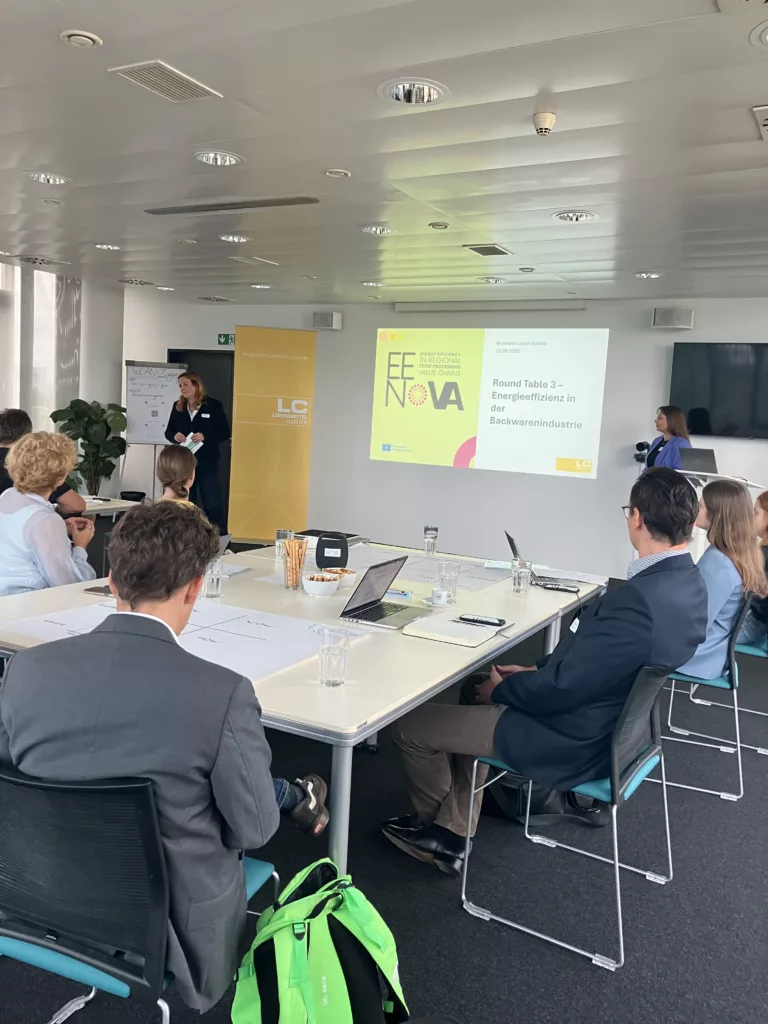
Across the discussions, several themes consistently emerged. Participants agreed that modernising infrastructure and improving heat recovery systems offer immediate and tangible benefits. Compressed air optimisation was considered an important opportunity, although implementation remains constrained by regulatory and financial hurdles. Photovoltaic expansion is widely supported but often slowed by questions of fire protection rules and funding availability. Participants had strong yet differing views on the usefulness of Energy Management Systems. Some considered EMS a necessary structural tool for long term optimisation, while others argued that its benefits are limited unless combined with concrete upgrades. E mobility was acknowledged as significant for logistics but currently unrealistic for heavy transport without stronger policy incentives. Overall, the Austrian session generated solutions deeply rooted in real operational and regulatory challenges.
Lithuania: Creating a Long Term Climate Neutrality Pathway for the Beverage Sector
The Lithuanian roundtable in Vilnius brought together 45 representatives from the water and soft drinks value chain, making it one of the largest consultation events within this phase of EENOVA. The session focused on refining the Clean Drinks 2050 scenario. This scenario outlines how the national beverage sector could achieve climate neutrality through a combination of energy efficiency, renewable integration, circular packaging systems, and improved supply chain coordination.

Participants reviewed the audit results and discussed how individual company measures such as installing photovoltaic systems, adopting building management technologies, improving packaging circularity, and sharing logistics resources could be aligned with Lithuania’s National Energy and Climate Plan and EU policies like Fit for 55 and CSRD. They agreed that the scenario is realistic but also dependent on addressing several long standing barriers. These include lengthy permitting procedures, limited access to dedicated financing, and supply challenges related to sustainable packaging materials. The roundtable highlighted the central role of digitalisation and data connectivity in enabling long term optimisation. It also reinforced the importance of collaboration across the cluster because individual companies cannot solve value chain bottlenecks alone.
Romania: Using Scenarios to Navigate Economic Pressures in the Meat Value Chain
The Romanian roundtable in Cluj Napoca addressed the meat value chain and focused on testing the feasibility of scenarios emerging from audit findings and earlier consultations. Companies validated the Baseline Scenario 2030 as both realistic and immediately valuable. Quick win measures such as LED upgrades and small scale photovoltaic installations were widely accepted and seen as financially prudent.

However, participants identified major structural issues that limit deeper energy transformation. Large companies face regulatory uncertainty regarding prosumer rules and renewable energy legislation. These companies are often required by law to meet higher standards yet cannot access public funding sources that support SMEs. This mismatch creates pressure to invest while limiting the means to do so. The roundtable emphasised the need for value chain collaboration, including shared logistics and cooperative infrastructure. Participants also highlighted the need for internal capacity building through dedicated energy managers and training on topics such as the Do No Significant Harm principle. The long term Strategic Transformation Scenario 2050 was considered important for Romania’s climate targets but not feasible without changes to the financing landscape.
What Roundtable 3 Reveals About Europe’s Food Industry Transition
Roundtable 3 accomplished exactly what the EENOVA methodology intended. All regions produced scenarios that reflect real industrial constraints while aligning with national and European policy requirements. Several themes appeared consistently across the five regions. Companies increasingly view energy efficiency as essential for competitiveness rather than an optional environmental improvement. Financing remains the most significant obstacle to implementing both short and long term measures. Renewable energy integration, particularly photovoltaic systems, is widely supported but often hindered by inconsistent regulations and slow permitting. Digitalisation and monitoring tools are considered necessary to optimise production and energy use. Capacity building, including skilled staff and specialised training, is essential for successful implementation.
What Comes Next
Roundtable 4 will take these validated scenarios and use them to develop a replicable model that can be applied not only within EENOVA’s five regional hubs but also across other food processing value chains in Europe. The transition from theory to practice requires structured collaboration, and EENOVA’s roundtable process is proving to be a robust framework for creating this shift.