Experience from five regional food-processing value chains across Europe shows that effective energy optimisation starts with cooperation, trust and coordination.
How can companies move from isolated energy measures to more strategic action across entire value chains? Recent experience in EENOVA points to a clear answer: successful energy optimisation is not only about technology, but also about governance. While individual energy audits remain an essential starting point, they do not fully capture the broader challenges and opportunities that arise when companies begin working together across a value chain. This broader perspective is important because value chain optimisation encompasses different topics than a single-company energy audit. Once companies look beyond their own operations, new issues come into focus, including logistics structures, coordination between actors, implementation barriers shared by several companies, joint scenario development, and the wider financing and policy context. In practice, this means that energy optimisation at value-chain level is not simply a scaled-up version of company-level action. It requires a different process, a wider analytical lens and a stronger focus on how companies interact with one another.
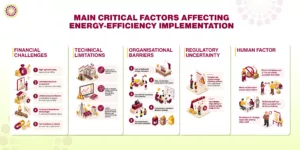
Across the five regional food-processing value chains involved, a common pattern has emerged: the most decisive barriers are often not purely technical, but organisational and human. Trust between actors, clear roles, communication inside and between companies, leadership commitment, and structured dialogue all play a central role in determining whether identified measures can actually be implemented. This is especially relevant in settings where companies have different levels of energy maturity, different investment capacities and different priorities within the same value chain. A governance-first approach helps address these challenges from the beginning. Rather than assuming that technical potential will automatically lead to implementation, it starts by creating the conditions for cooperation. This includes neutral facilitation, a structured step-by-step process, and dedicated spaces for exchange between companies and other relevant stakeholders. In this way, companies can jointly identify barriers, align expectations, discuss synergies and build a common understanding of what is possible at both company and value-chain level. This approach also helps to connect technical findings with broader strategic questions. Once companies enter into dialogue, the discussion naturally expands beyond energy-saving measures alone. Issues such as supply chain organisation, logistics optimisation, renewable energy integration, financing options, regulatory conditions and long-term transition pathways become part of the conversation. This creates added value because many opportunities only become visible when companies consider their interdependencies rather than acting in isolation.

Another important lesson is the role of neutral intermediaries. Experience shows that companies benefit from a trusted facilitator that can moderate discussions, support role clarification, and help maintain momentum throughout the process. This kind of facilitation is particularly valuable where collaboration does not yet exist in a structured form or where sensitive issues, such as investment priorities, coordination responsibilities or data sharing, need to be addressed carefully. A neutral intermediary can help create the trust and continuity needed to move from discussion to action.
The experience from EENOVA also shows that governance-based approaches are relevant across very different regional and sectoral contexts. Although the participating value chains faced different technical challenges and local conditions, the need for stronger cooperation structures was a recurring theme throughout. This suggests that governance is not a secondary issue, but a core component of successful value-chain energy optimisation. It is what enables companies to translate individual audit results into coordinated pathways for energy efficiency, renewable energy uptake and longer-term transformation. At the same time, the work highlights that stronger collaboration can open the door to more scalable and transferable solutions. By combining company-level evidence with value-chain dialogue and policy reflection, it becomes possible to identify approaches that are not only relevant for one company or one region, but also useful for replication in other sectors and countries. This is particularly important for accelerating the clean energy transition in practice, where implementation depends as much on cooperation and alignment as on technical feasibility.
Taken together, these insights underline a key message: energy optimisation across value chains begins long before concrete investments are made. It begins with communication, trust-building, role clarification and a shared willingness to act together. Technical solutions remain essential, but without the right governance framework, their impact is likely to remain fragmented. EENOVA shows that the path to more efficient, resilient and future-oriented value chains begins with stronger governance and better cooperation.